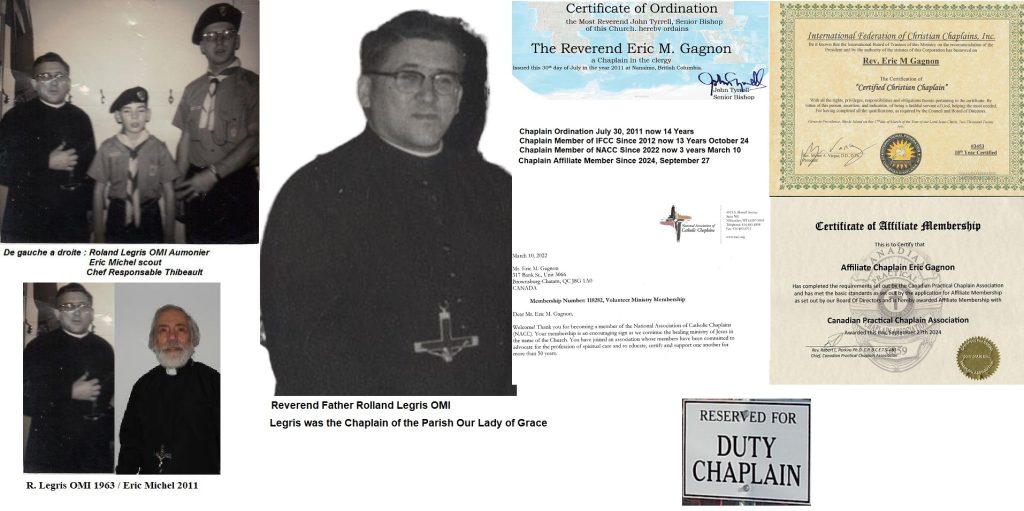
FSSP Lapel Pin

An “FSSP church” refers to a parish or apostolate served by the Priestly Fraternity of Saint Peter (FSSP), a traditionalist Catholic clerical society of apostolic life for priests who celebrate the traditional Latin Mass. The FSSP is in communion with the Holy See and focuses on preserving and promoting the use of the extraordinary form of the Roman Rite within the Catholic Church.

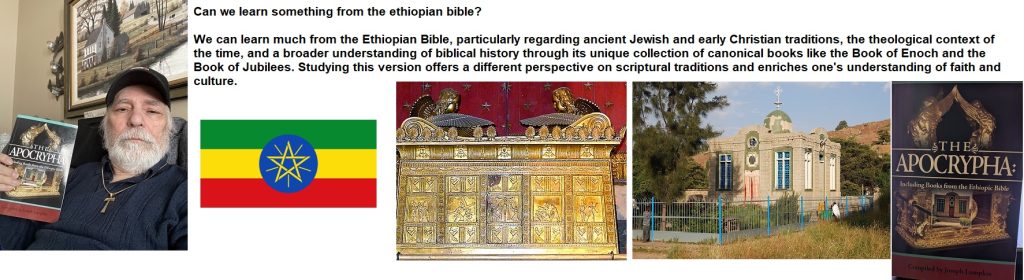
Can we learn something from the ethiopian bible?

We can learn much from the Ethiopian Bible, particularly regarding ancient Jewish and early Christian traditions, the theological context of the time, and a broader understanding of biblical history through its unique collection of canonical books, such as the Book of Enoch and the Book of Jubilees. Studying this version provides a distinct perspective on scriptural traditions and deepens one’s understanding of faith and culture.

What You Can Learn from the Ethiopian Bible

Deeper Biblical History and Spirituality:
The Book of Enoch, the Book of Jubilees, and other unique texts offer a broader perspective on ancient traditions and beliefs than those found in other standard Bibles.

Jewish Thought and Angelology:
These additional books offer insights into Jewish thought in the centuries preceding Christianity and elaborate on topics such as angels and the early days of the world.

Theological and Cultural Context:
As one of the oldest and most complete versions of the Bible, its narratives reveal the theological and cultural context of its time, offering a unique glimpse into early Christian traditions.

Different Canons and Traditions:
The Ethiopian Bible includes books not found in the canons of most other Christian denominations, which highlights the diverse ways Christian traditions have evolved and how different churches have arrived at different understandings of scripture.

Cultural Heritage and Inclusivity:
The Ethiopian Bible is a testament to Ethiopia’s rich Christian history and serves as a significant cultural artifact. Its inclusivity is also evident in its original format, which features illustrations and large print for accessibility, promoting an inclusive approach to studying sacred texts.

Key Books in the Ethiopian Canon
The Ethiopian Bible includes numerous books not found in other Christian Bibles. Some of the most notable are:
The Book of Enoch offers a unique perspective on Jewish angelology and cosmology.
Book of Jubilees: Also known as the “Little Genesis,” it recounts biblical history from creation to the time of Moses in a distinctive manner.
The Ascension of Isaiah: Another significant text preserved in the Ethiopian tradition.

You can learn about early Christian history, the development of biblical canons, and alternative theological concepts from the Ethiopian Bible. It offers unique perspectives not found in the Western biblical tradition by including books such as Enoch and Jubilees.

Context of the Ethiopian Bible

The Ethiopian Bible, or the broader canon of the Ethiopian Orthodox Tewahedo Church (EOTC), contains more books than the canons of the Protestant, Catholic, and Eastern Orthodox churches. Scholars study its manuscripts, many of which were written in the ancient Ge’ez language, for insight into the theological and historical contexts of early Christianity.

Key lessons and insights

Early Christian and Jewish history
The EOTC canon offers a window into the evolution of religious ideas in the Second Temple period (roughly 516 BCE–70 CE) and early Christianity. The discovery of Aramaic fragments of some of these texts among the Dead Sea Scrolls confirmed their ancient origins and influence on early religious thought.

Unique narratives and expanded theology
The Ethiopian Bible includes several books considered apocryphal by other traditions, revealing unique theological concepts.
The Book of Enoch describes the fall of the Watchers (angels who fathered the Nephilim) and provides vivid detail on divine judgment and the fate of the righteous and the wicked. It is even quoted in the New Testament Book of Jude.

The Book of Jubilees: This retelling of Genesis and part of Exodus uses a different, solar-based calendar and expands on early biblical history.
The Ethiopian Book of Clement: A unique version of this text that narrates how Peter mentored Clement.
Ethiopian Maccabees (Meqabyan): Three books distinct from the Books of Maccabees in other Bibles, which focus on the martyrdoms of Jews.
Paralipomena of Jeremiah (4 Baruch): Presents an alternative account of the prophet Jeremiah following the destruction of Jerusalem.

Distinctive liturgical and spiritual traditions
The EOTC’s unique texts and interpretations have shaped a distinct spiritual identity, including its rich traditions of art, music, and liturgical practices. For example:
Its emphasis on angels and eschatology (the study of last things) is strongly influenced by the Books of Enoch and Jubilees.
Ancient manuscripts often include vibrant illustrations, reflecting the church’s unique aesthetic tradition.
English translations of the complete EOTC canon support interfaith dialogue and offer valuable resources for academic study.

Resilience and diversity of faith
The preservation of these ancient texts in Ethiopia, mainly due to its relative isolation from Western Christendom, is a testament to the resilience of its Christian heritage. It demonstrates the diverse expressions and interpretations of early Christianity that existed beyond the Roman and Byzantine spheres.

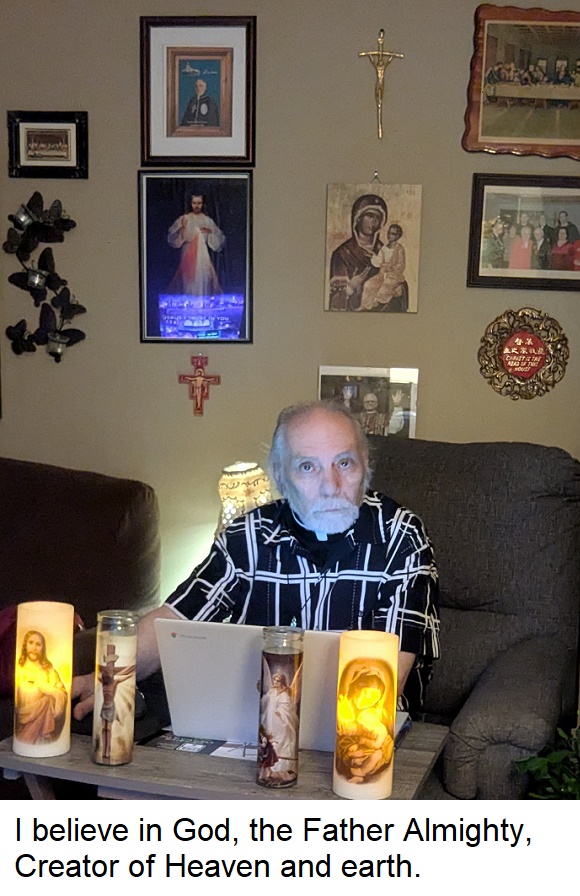
I believe in God

I believe in God,
the Father Almighty,
Creator of Heaven and Earth.

Remember this prayer?
People recite it without thinking.
However, this is a huge statement.
How do we know that God exist?
The catechism teaches us that we must believe in God
because it is a revealed truth, as stated in the Apostles’ Creed.
However, is this enough to make it believable?
Further down on the same page of the catechism, it states, “How did God reveal Himself?” Answer by the visible world that He created.
Many moons ago, I wrote a thesis titled ‘And God Created the Big Bang.’
Many argue against this theory, but until it is proven otherwise, we will retain it as a possibility.
The Jesuit Priest Robert Spitzer says, ” If at the beginning it had nothing, you need someone or something that sparks the universe because the logic says from nothing cannot be turned into something, nothing + nothing = nothing.

Another time, I was a big fan of RTB. The Canadian astronomer Hugh Ross founded the ministry “Reasons to Believe” (RTB) because he concluded that a scientific understanding of cosmology and the universe’s “fine-tuning” points to God as the Creator, and that this evidence is consistent with the accuracy and inspiration of the Christian Bible. Ross believes science, rather than contradicting faith, provides “new evidence from the book of nature” that supports Christian beliefs and the existence of a personal, transcendent God. This statement has nothing to do with the eccentric Kenneth Alfred Ham.

Did you ever sit on your balcony and watch animals around for a long time? Trying to understand their behaviour, amazing what came out from them, how they get out of a bad situation.

Have you ever watched the water, flowers, and trees?
In nature, God reveal Himself.

Did you know that animals, plants and trees communicate among their own species?

Evolution, in which I agree, does not explain everything. We need to look further for an explanation.

I believe in God,
the Father Almighty,
Creator of Heaven and Earth.

IS IT TRUE THAT THE SECOND VATICAN COUNCIL CONDEMNS THE APOSTLE PAUL?

Many priests and pastors have invited me to visit their countries to preach, even for an online sermon, and I always decline. I do not know how, and I am not interested in learning; it is not for me.

But I am a teacher and I love to teach, now to the topic:

A friend on Facebook posted a long story about
IS IT TRUE THAT THE SECOND VATICAN COUNCIL CONDEMNS THE APOSTLE PAUL?

There is an important question regarding “The Second Vatican Council and the Condemnation of the Apostle Paul”…

So, I need to reply: Next time, search the internet to verify the story before posting it.

I told him that it was a false statement and why

He replied: I will not argue with it Neither to You Bishop,,, that’s why the Praise is question mark right?…

…we should teach the whole truth, not half-truth, for we are accountable to that when we face Jesus Christ Our Saviour. We should practice truthfully through God, not for pleasing people in this earthly world.

I replied: If you want to teach the actual teaching of Jesus, you need to convert to the Jewish faith.

He answered to that: what? Don’t deceive
Me,,, Jewish teaching is telling the truth? You exposed your true color,,, never,,, Jesus Christ has his own True Church founded 33AD entrusted to Peter ( Matthew 16: 18 – 19,,, 28:19 – 20 ),,, as per my knowledge Jewish Teaching is half Truth… Half truth is a Sin… Go your Way and I will go my way,let met in cross Road to face Jesus Christ Our Saviour which crucifhed by Jewish Teacher of the Law Brived Jewish People to Let Pilate convict Jesus to be crucifhed, amen…

Now, my last reply to my statement:
What does Catholicism say about this statement: Jesus was a Jewish Teacher, teaching Jewish faith to Jewish people.

Catholics affirm that Jesus was a Jew, born into a Jewish family and practicing the Jewish faith. He taught Jews, but his message was also intended for all people. His teachings were rooted in and built upon the Jewish tradition, and he considered himself the fulfillment of Jewish prophecies.

This is supported by the New Testament, which portrays Jesus as a devout Jew who observed the Torah and taught in synagogues.
Some key points to understand regarding Catholics’ perspective on Jesus’ Jewish identity:

Jesus as a Rabbi:
Catholics recognize Jesus as a Rabbi, a teacher of Jewish law and tradition. He taught in synagogues and emphasized the importance of fulfilling the Torah.

Continuity and Newness:
While Jesus taught within the Jewish tradition, his message introduced a new covenant and understanding of God. Catholics believe that Jesus’ ministry completed and fulfilled Judaism, not abolished it.

The Role of the Jewish People:
Catholics acknowledge the special relationship God has with the Jewish people. They believe that Jews are God’s chosen people and that Jesus came to bring salvation to all people, including Jews.

It’s important to note that while Catholics acknowledge Jesus’ Jewish identity, there can be different interpretations of his mission and relationship with Judaism. Some theological discussions focus on the nature of his divinity and the relationship between Christianity and Judaism. However, the core belief that Jesus was a Jew who taught Jews remains consistent within Catholic theology.

For a more nuanced understanding of Catholic perspectives on Jews and Judaism, consider exploring documents like the Second Vatican Council’s “Nostra Aetate”, which addresses interreligious relations and emphasizes the shared heritage of Christians and Jews.

What Catholic says about this statement: Jesus was a Jewish Teacher, teaching Jewish faith to Jewish people.

The Catholic Church recognizes Jesus’ Jewish identity and his roots within Judaism.

Explanation
Jesus was Jewish: The Catechism of the Catholic Church states that Jesus was “born a Jew of a daughter of Israel”. He grew up observing Jewish scriptures, customs, and traditions.

Jesus taught Jewish people: During his earthly ministry, Jesus primarily taught Jewish people in Galilee and Jerusalem, and his message was rooted in Jewish scripture and prophecy.

The Fulfillment of Judaism: Catholic teaching sees Jesus’ ministry as the fulfillment of the Old Covenant and the Jewish faith, establishing a New Covenant for all people.

However, the Catholic Church does not believe Jesus’ teachings were exclusively for Jewish people, nor did he intend to create a movement solely within Judaism.

A Universal Message: Jesus’ instructions to his disciples included the command to make disciples of “all nations,” signifying a mission beyond the Jewish community to bring the gospel to the Gentiles. This indicates a broader, universal scope for his teachings and the resulting Church, which is open to people of all backgrounds.
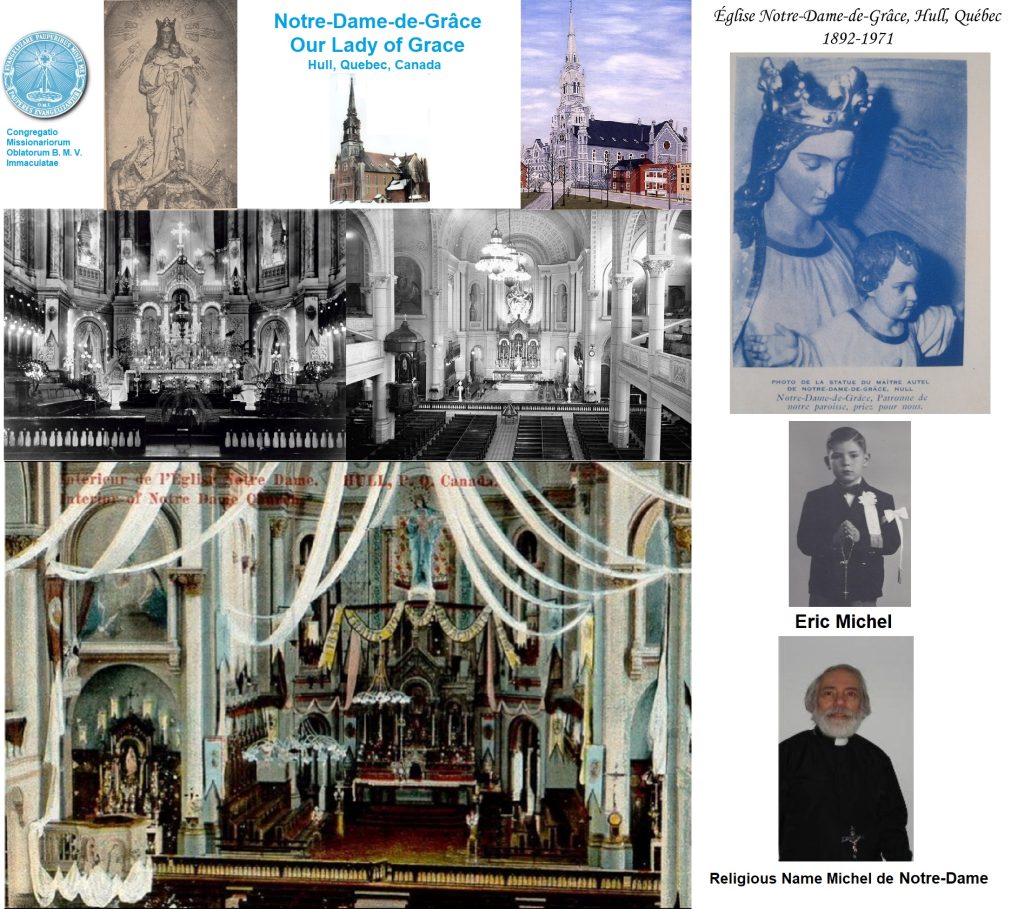
Our Lady of Grace

The first settlers, accompanied by Philemon Wright, settled in Hull in 1800, probably near Lake Leamy. The following year, Philemon Wright built a sawmill and a flour mill near Chaudière Falls. The town of Hull grew rapidly and became one of the largest cities in Quebec, with a population of 800 inhabitants by 1824. The name Hull recalls the city of the same name in the United Kingdom, where Philemon Wright was originally from.

The parish of Notre-Dame-de-Grâce was canonically erected on 14 November 1870. It was then entrusted to the Congregation of Oblates. A first chapel was built in 1846. The construction of a stone church took place from 1868 to 1874. It was blessed in 1870 by Bishop Eugène Bruno Guigues of Ottawa. On 5 June 1888, a major fire destroyed several buildings, including the church. The latter was quickly rebuilt, and Bishop Thomas Duhamel came to bless it in 1892. This second church, in turn, burned down on 12 December 1971. It was not rebuilt. It was located at the corner of Notre-Dame-de-l’Île and Victoria streets in Gatineau.

My parish belongs to the Roman Catholic Diocese of Ottawa.

My decision to become a Chaplain.

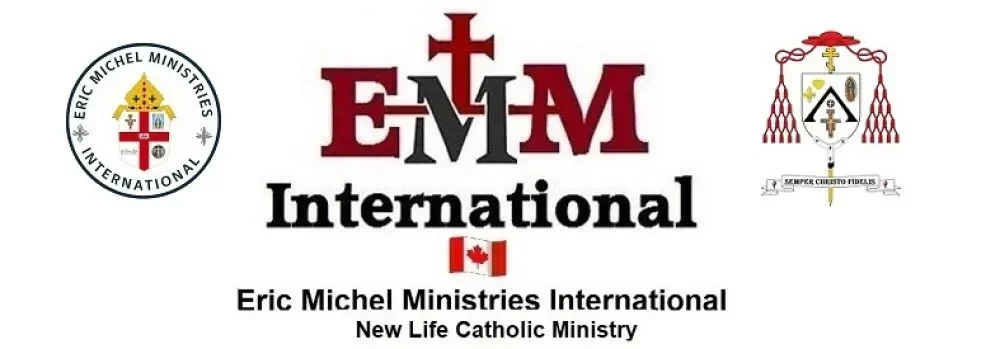
Two factors from my youth that contributed to my decision to become a Chaplain. First, our Parish Chaplain, Father Legris, and the Scout movement began as Wolf Cubs and later evolved into Boy Scouts, where I learned to be of service and always be ready to help someone. In my mind, I had been a chaplain since my teenage years. The desire to help led me to become a Street Outreach Worker in French, “Travailleur de rue,” for an addiction center in 1993, and a Bivocational Minister since 1988. I was there, but not entirely.

So, it was normal to have the goal of becoming a real Chaplain working for the church. I was ordained a Chaplain in 2011. I have been working for the International Federation of Christian Chaplains since 14 November 2012. (https://www.facebook.com/ChaplainFederation) .

During my training with Révérend Michel Beaumier of the Evangelical Christian Church of Lorraine, on our way to lunch, walking side by side, he asked me why I didn’t have my own chaplaincy.

From this, I worked toward this new goal, my own chaplaincy. It took me two years, and it happened in 2014, when I registered with the federal government on 14 July. The Reverend Mary joined me in May 2012. She is a Baptist Minister, and we raised the chaplaincy until 2020 when I decided to become Catholic. Franciscan one.

I joined the National Association of Catholic Chaplains on 10 March 2022 (https://www.facebook.com/choosechaplaincy)

As the NACC and the IFCC are American, I sought a Canadian Chaplaincy, which I found and became an Affiliate on 27 September 2024 at the Canadian Practical Chaplain Association (https://www.facebook.com/profile.php?id=100064838522731).

However, the Ministries remained Protestant, and after a resolution by the House of Bishops and the Board of Elders, the organization Eric Michel Ministries International became Catholic and requested an Amendment to our constitution, which Corporation Canada granted on 14 January 2025.

REF.: https://franciscanseucharist.com/?page_id=64